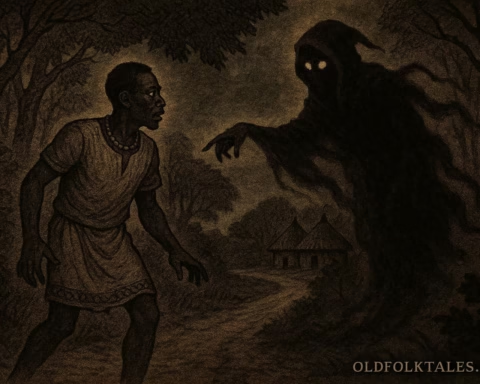
In a distant land, eight days’ journey from the nearest settlement, there once stood a village that appeared much like any other. Thatched roofs covered modest compounds, rivers wound through green valleys, and the sounds of village life filled the air. Yet beneath this ordinary appearance lay a terrible secret. The village harboured a darkness so dreadful that even the hyenas, which people say never eat their own young, would have recoiled in horror.
At the heart of the settlement stood an enormous house where the village men gathered to feast on human flesh. They had abandoned every bond of humanity and given themselves over to cannibalism. The men took turns travelling beyond the village to hunt for victims, carrying their captives home in woven bendjob bags as though they were ordinary game caught in the forest.
Whenever a hunter returned with a victim, he presented himself before the king. The king would then mount the ceremonial drum and beat it, sending its deep, hollow sounds across the surrounding countryside.
“Dum dum dum dum dum!”
The rhythmic call, “Gwudum gwudum gwudum gwudum!” summoned all the men of the village to the great house. At the sound of the drums, they abandoned whatever they were doing and hurried to join the feast.
One day, a hunter from this dreadful village travelled far beyond his usual hunting grounds. During his journey, he came upon a young girl alone in her family compound. Her parents were away working on their farm, leaving their only daughter at home. She was the pride and joy of their family, but the hunter saw nothing but another victim for his village’s terrible feasts.
Without hesitation, he seized the child, pushed her into his bendjob bag and set off for home.
When evening came, the girl’s parents returned from their farm and discovered that their daughter was missing. They called her name and searched every corner of their compound, but there was no answer. They went from house to house, climbed the surrounding hills and searched the forests, hoping to find some trace of her.
Explore more stories from our Cameroonian Folktales Collections archive.
Days turned into weeks, but the child remained missing. Eventually, hope began to fade. The elders, believing that wild animals might have carried her away, poured libations for the dead, and funeral rites were performed.
The mother, however, was overwhelmed by grief. Unable to find comfort in her daughter’s disappearance, she spent her days mourning.
Seeing her suffering, some neighbouring women decided to help her. They encouraged her to accompany them to their farm, hoping that the work would distract her from her sorrow.
“Come and help us make beds for sweet yams and achu-cocoyams,” they urged. “The work may help ease your pain and give your heart some rest.”
The mother eventually agreed. Their farm was situated near a well-travelled path, where people frequently passed on their journeys.
As the women worked beneath the morning sun, they prepared rectangular beds using grass and twigs before covering them with rich soil. Nearby, fires burned continuously beneath the heaps of earth, creating hot beds in which cocoyams could be roasted. The women were familiar with the crackling sounds of the flames, which continued to burn for days.
It was while they were working that the very hunter who had stolen the little girl appeared along the path.
He greeted them pleasantly.
“My mothers, I commend your work.”
“Eeh loo,” the women replied together.
“I am terribly hungry,” he continued, scratching his throat. “Would you please give me something to eat? When I have finished eating, my bag will sing beautifully for you.”
The grieving mother, moved by his request, immediately offered to prepare something for him. She hurried to gather some cocoyams and approached one of the smouldering beds where the food was roasting. Using a stick, she widened an opening in the hot ashes and placed the cocoyams inside.
The skins rustled as they roasted.
“Twa, twa, twa, twa.”
When the food was ready, she gave it to the traveller, who ate until he was satisfied.
Afterwards, he opened his bendjob bag and instructed its hidden contents to eat the remaining peelings.
“Eat and sing for these women,” he commanded.
To the mother’s astonishment, a familiar voice emerged from inside the bag. It sang:
tanda meyase djo, misi yie, u fiake mi boro wato, wandele wa, wandele selenge, wandele senge senge.
The mother listened closely. There was something about the voice that stirred a deep recognition within her. It sounded painfully familiar, like the voice of someone she had spent weeks searching for.
“Your bag sings so sweetly,” she remarked. “Please, could it sing for us once more?”
The hunter obliged, and the voice repeated its song. This time, the mother was certain that the voice belonged to her missing daughter.
She needed to act quickly, but she could not allow the hunter to suspect that she had recognised the child.
When the man complained that his throat was dry and asked for water, the mother saw an opportunity.
“Go to the spring nearby,” she told him. “It is only three furrows away.”
The hunter took his calabash and set off towards the spring. But as he walked, the mother used her supernatural powers to move the water farther away. Each time he thought he was getting closer, the spring seemed to recede. He continued walking, unaware that the distance was being extended by the woman’s magic.
While he was occupied searching for water, the mother quickly opened the bendjob bag and rescued her daughter. She hid the child among the thick shrubs nearby. Then, gathering a swarm of angry bees, she placed them inside the bag and sealed it shut.
By the time the hunter returned with his water, the mother had completed the exchange. He collected his bag, unaware that the child he had stolen was no longer inside.
The journey back to his village became increasingly difficult. The bag seemed much heavier than before, and whenever the hunter demanded that it sing, the familiar melody was replaced by a low, ominous buzzing.
He stopped several times along the way, hoping to hear the song again. But each time he commanded the bag to sing, the buzzing grew louder and more threatening.
Eventually, he reached his village and presented himself before the king, announcing that he had returned with his catch.
The king immediately mounted the ceremonial drum and began to beat it with great enthusiasm. Its familiar sound travelled across the settlement, summoning the men to the great house.
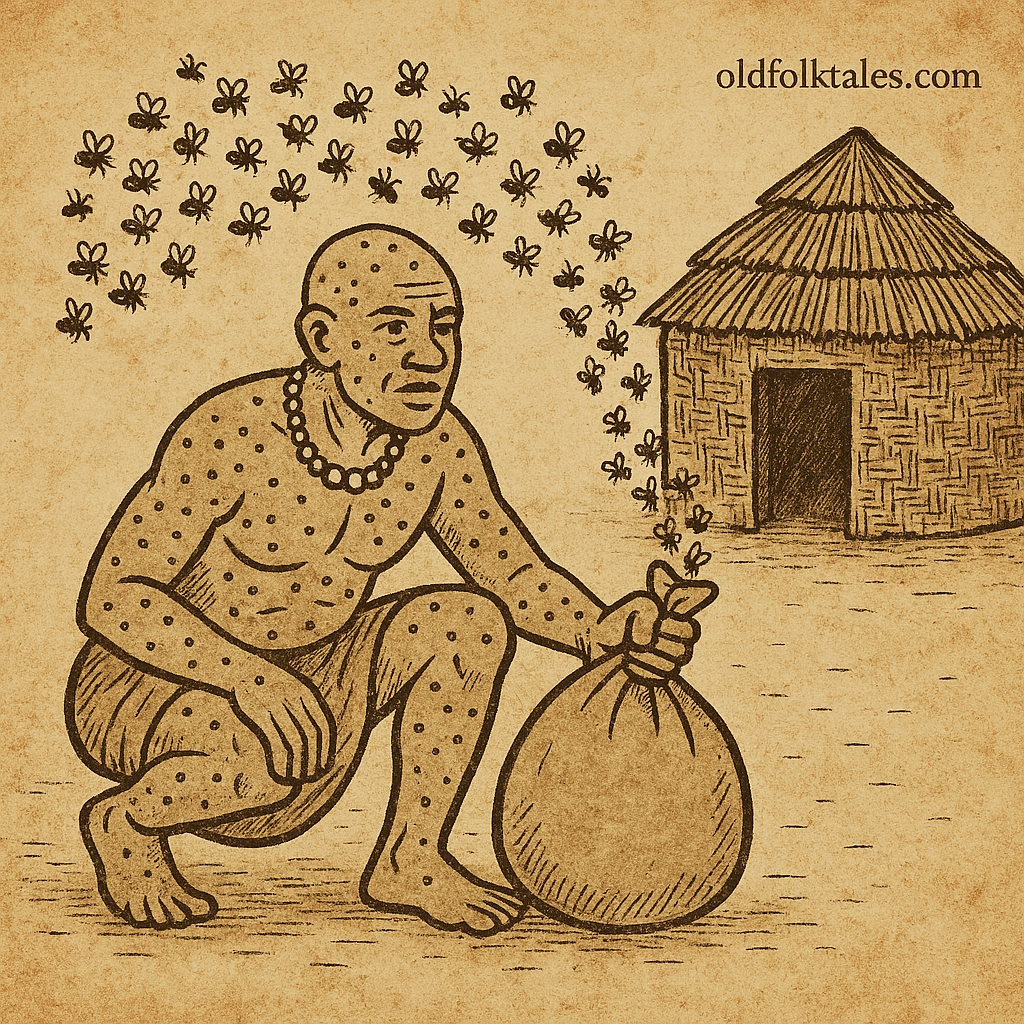
Among the villagers, however, there was one man who had never been invited to their terrible feasts. He was known as nfo nkwagh, meaning King-of-Scabies. His entire body was covered with festering sores, and the villagers feared that he would contaminate them. For this reason, the king had banished him from the settlement, forcing him to live beneath rocks in the forest.
When King-of-Scabies heard the ceremonial drums, he emerged from his hiding place and made his way towards the great house. He arrived before the other men and, knowing that something terrible might happen, prepared a means of escape.
He dug a hole in the ground, covered its opening with a flat stone and created a concealed passage leading outside. Having completed his preparations, he withdrew into the shadows and waited.
Soon, the cannibals began arriving. They came carrying their drinking horns and palm wine, eager to celebrate the latest hunt. As darkness settled, they gathered for their feast and demanded that the victim be brought forward.
Four men struggled to lift the bendjob bag, surprised by its extraordinary weight. They carried it towards the place where the victim was to be prepared.
The moment they opened the bag, the terrible consequence of their wickedness was unleashed.
“Zuuzuuu! Zuuzuuu! Zuuzuuh!”
A furious swarm of bees burst out of the bag, filling the house and attacking everyone inside. The men screamed and struggled to escape, but the bees covered the exits and pursued them relentlessly. Their stings brought death to the cannibals, one after another.
Only King-of-Scabies escaped. Protected by his badly scarred skin, which left the bees no unmarked flesh to sting, he quickly removed the stone covering his concealed passage and fled through it.
When the buzzing finally subsided, he returned to discover that he was the only surviving man in the village.
The women and children soon gathered, having heard the royal drums sounding in a manner they had never heard before. They wanted to know what had happened inside the great house.
When they discovered that the cannibals had been destroyed by the bees, they did not shed tears for the men who had terrorised their community. Instead, they collected every drop of oil and kerosene they could find in their homes and set the house of abomination on fire.
The flames rose high into the night, creating a great blaze that could be seen from villages many days away.
Thus ended the reign of terror in the cannibal village.
Explore our complete Historic Folklore & Fairy-Tale Collections archive.
Moral Lesson
This folktale reminds us that evil and cruelty eventually bring destruction upon those who practise them. The cannibals believed that their power and wicked traditions made them untouchable, but their downfall came through an unexpected instrument of justice. The story also highlights the danger of judging others by their appearance or social standing. King-of-Scabies, rejected and driven into exile by his community, became the only man to survive the destruction. Sometimes, those whom society overlooks or despises may possess the wisdom and strength needed to overcome great evil.
Knowledge Check
Q1: Why was the village feared, and what terrible practice did its men follow?
A1: The village was home to a group of cannibals who hunted human beings and gathered in a great house to feast on their victims.
Q2: What was the significance of the bendjob bag in the story?
A2: The bendjob was the woven bag the cannibals used to carry their victims. It became the instrument of their destruction when the grieving mother replaced her stolen daughter with a swarm of angry bees.
Q3: How did the mother recognise her missing daughter?
A3: When the hunter stopped at the farm to eat, he commanded the contents of his bag to sing. The mother recognised the familiar voice of her daughter coming from inside it.
Q4: How did the mother rescue her daughter and deceive the hunter?
A4: She used her supernatural powers to move the spring farther away, keeping the hunter occupied while she freed her daughter. She then filled the bag with bees before sealing it and allowing the hunter to return home.
Q5: Who was King-of-Scabies, and why had he been banished?
A5: Known as nfo nkwagh, King-of-Scabies was a man whose body was covered with sores. The villagers feared contamination and forced him to live beneath rocks in the forest. He eventually became the only surviving man after the bees attacked the cannibals.
Q6: How did the cannibals meet their end?
A6: When the men opened the bendjob bag to reveal their victim, a swarm of angry bees burst out and attacked them. The bees killed the cannibals, while King-of-Scabies escaped through a concealed passage he had prepared.
Q7: What does the survival of King-of-Scabies teach us?
A7: His survival highlights the danger of judging people by their outward appearance or social position. Although the villagers rejected him, he became the sole male survivor of the destruction that overtook their community.
Source
Adapted from The Sacred Door and Other Stories: Cameroon Folktales of the Beba, first edition, published by Ohio University Press.
Explore More Cameroonian Folktales
- The Sacred Forests of the Bakossi
- The Water Ceremony
- The Keeper of the Royal Drum of Bafut
- The Great Canoes of the Wouri
- The Festival of the Elephant Masks
- The Iron Masters of the Mandara Hills
- The Great Market of Maroua
- The Counsel of the Bamum Queen Mother
- The Night Market Where Humans Trade with Spirits